
January 23, 2023
76% of Algerians believe men are better at political leadership than women
Most Algerians are for separating men and women in the workplace, citing sexual harassment concerns.
Most Algerians are for separating men and women in the workplace, citing sexual harassment concerns.

Young men and women candidates running for Algeria’s upcoming legislative elections are considered an asset amid a predicted record low turnout.

An opposition party in Algeria two

Parties in Bordj Bou Arreridj Provi

Algerian law requires the next parl
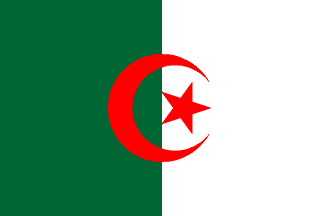
| Quota Information | Parliament Information | ||
|---|---|---|---|
| Are there legislated quotas? | Yes | Structure of parliament | Unicameral |
| For the Single/Lower House? | Yes | >Current members | 407 |
| Percentage of women | 8.00% | ||
| Source: Gender Quotas Database | Source: New Parline | ||
Most Algerians are for separating men and women in the workplace, citing sexual harassment concerns.
Young men and women candidates running for Algeria’s upcoming legislative elections are considered an asset amid a predicted record low turnout.
An opposition party in Algeria two
Parties in Bordj Bou Arreridj Provi
Algerian law requires the next parl
Despite efforts by Algeria's political parties, few women are running for office in the country’s double elections on Thursday (November 29th). While many women work in the civil service, education, justice and health sectors, the number of those involved in politics remains low.
Having battled for over twenty years against the Family Code, Algerian women now face a new challenge. Unlike their elders, whose aim was to get the Family Code amended, young Algerian women today are campaigning for greater political representation and equality of access to top jobs.
Secretary General of Algeria's Workers' Party Louisa Hanoune, who was the only woman in this year's presidential race, said that her staff has appealed to the Constitutional Council over what she called a case of election "fraud." Her remarks came a day after the official announcement of the prel
Elite women in Kailahun under the network, Kailahun District Women in Governance Network (KWiGN) have declared interest to vote only for parties with clear gender issues.
Reinforcing presumed religious identities:
Where are women and secularists of Muslim countries in Obama’s speech in Cairo?
by Marieme Helie Lucas
Secularism is a Women's Issue (SIAWI)
| Quota Information | Parliament Information | ||
|---|---|---|---|
| Are there legislated quotas? | Yes | Structure of parliament | Unicameral |
| For the Single/Lower House? | Yes | >Current members | 407 |
| Percentage of women | 8.00% | ||
| Source: Gender Quotas Database | Source: New Parline | ||
Most Algerians are for separating men and women in the workplace, citing sexual harassment concerns.
Young men and women candidates running for Algeria’s upcoming legislative elections are considered an asset amid a predicted record low turnout.
An opposition party in Algeria two
Parties in Bordj Bou Arreridj Provi
Algerian law requires the next parl
Despite efforts by Algeria's political parties, few women are running for office in the country’s double elections on Thursday (November 29th). While many women work in the civil service, education, justice and health sectors, the number of those involved in politics remains low.
Having battled for over twenty years against the Family Code, Algerian women now face a new challenge. Unlike their elders, whose aim was to get the Family Code amended, young Algerian women today are campaigning for greater political representation and equality of access to top jobs.
Secretary General of Algeria's Workers' Party Louisa Hanoune, who was the only woman in this year's presidential race, said that her staff has appealed to the Constitutional Council over what she called a case of election "fraud." Her remarks came a day after the official announcement of the prel
Elite women in Kailahun under the network, Kailahun District Women in Governance Network (KWiGN) have declared interest to vote only for parties with clear gender issues.
Reinforcing presumed religious identities:
Where are women and secularists of Muslim countries in Obama’s speech in Cairo?
by Marieme Helie Lucas
Secularism is a Women's Issue (SIAWI)
KOLEA, Algeria: A string of white pearls around her neck, her hair tied in a bun, Louisa Hanoune, the only woman running for Algeria’s presidency, holds out her palms and declares: “I have clean hands.”