Women's Leadership

Women in politics are, historically speaking, newcomers to a field built without them in mind.
Women may now hold seats at political tables, but those tables were never designed for them, and the violence, scrutiny and hostility they face are not anomalies but symptoms of systems still shaped by exclusion.
In Mexico, President Claudia Sheinbaum, celebrated as the nation’s first woman elected to the role, was sexually assaulted in broad daylight during a public event.
The assault was shocking, but perhaps more alarming was how quickly some dismissed it as just another hazard of public life. Her experience exposes the ongoing physical vulnerability women leaders continue to face, as well as the troubling tendency to minimize violence against them as inevitable rather than unacceptable. Power does not insulate women from misogyny; in many cases, it makes them more visible targets.
Closer to home, Montreal’s women mayors navigate a political terrain that looks welcoming on paper but feels far less in practice.
Their experiences show how the everyday labour of governing becomes gendered; from constant online harassment to double standards that shape expectations of tone, behaviour and even wardrobe. Their professionalism is evaluated alongside irrelevant criteria, sending the same persistent message: you can sit at the table, but don’t get too comfortable.

Milestones: Gina Raimondo became the first woman governor of Rhode Island (2015); Marian Anderson is the first African American woman to sing at the Metropolitan Opera; Ella Grasso became the first woman governor of Connecticut (1975); Anna Pauline “Pauli” Murray is the first African American woman ordained to the Episcopal priesthood (1977); Kay A. Orr, became the first woman governor of Nebraska (1987); Sen. Aaron Sargent introduced a resolution, written by Susan B. Anthony, to Congress for Women’s Suffrage Amendment (1878); Madeleine M. Kunin, first Jewish woman governor and first woman to serve three terms as governor in Vermont; Victoria Woodhull, first woman to address a House Committee, argues for women’s suffrage (1871); and Amelia Earhart makes the first solo flight from Hawaii to North America.
Birthdays for notable women: Kate McKinnon, actor and LGBTQ activist; Katie Couric, journalist; Zora Neale Hurston, author (1891); Kaia Los Huertos; Kate Stewart, Montgomery County Council; Carrie Chapman Catt, suffragist and peace activist (1859); Sian Leah Beilock, former president of Barnard College and current president of Dartmouth; Sarah Jane Higginbotham, co-founder of Harrison Clark LLC and the National Women’s Defense League; Anna Kellar, national organizing director at Rank the Vote; Alice Paul, Quaker, suffragist, author of the Equal Rights Amendment (1885).

This data story looks at the economic empowerment of women over the past decade and a half across selected Middle East and North Africa (MENA) countries (Algeria, Bahrain, Egypt, Iraq, Jordan, Kuwait, Liban, Libya, Morocco, Oman, Palestine*, Qatar, Saudi Arabia, Syria, Tunisia, and the United Arab Emirates). It sets out a few stylised facts on how education, labour markets, laws, and public opinion shape women’s opportunities**. It also looks at how economic realities interact with cultural norms and legal structures across the region. Most importantly, it asks a central question: are women agents of change in their own economic and political trajectories, and how is that visible in the data that follows?
This issue goes beyond human rights or social and economic concerns and directly affects the region’s political and security landscape. As women gain greater opportunities to work, earn and participate in public life, they strengthen the resilience of families and communities, which supports broader social stability and – as research has consistently shown – contributes to higher levels of security and peace.

When the 1967 Abortion Act cleared parliament, marking one of the most significant steps forward for women’s rights in history, Diane Munday was among the campaigners raising a glass of champagne on the terrace of the House of Commons.
“I’m only drinking a half a glass,” she told her colleagues at the time, “because the job is only half done.”
And, she was right. “Fifty years later, women were still going to prison,” says Munday, who co-founded the British Pregnancy Advice Service. She was also a leading member of the Abortion Law Reform Association during the 1960s and 1970s and is a patron of Humanists UK.
The 94-year-old campaigner still spends most of her days at work in her home office, where evidence of her passion is clear: from the bookshelf stacked with titles about abortion, to the notes tacked above her desk, to the filing cabinet stuffed with decades of history.

In the turbulent Venezuelan political landscape of early 2026, Delcy Eloína Rodríguez Gómez has emerged as a central figure in the transition following the capture of President Nicolás Maduro by U.S. forces. At 56, and with a long trajectory inside chavismo, Rodríguez assumed office as interim president of Venezuela on January 5, 2026, after the Supreme Court ordered her constitutional elevation in order to “guarantee administrative continuity and the comprehensive defense of the State.”
Born in Caracas on May 18, 1969, Rodríguez is a lawyer by profession, trained in labor law, with a political career that began in technical government posts in the 2000s and solidified after the death of Hugo Chávez and Nicolás Maduro’s rise to power in 2013. Her résumé includes positions such as Minister of Communication and Information, Minister of Foreign Affairs, President of the National Constituent Assembly, and since 2018 Vice President of the Republic. In the years leading up to 2026, she also held responsibilities tied to the economy and the oil industry, placing her among the most influential figures inside the regime.

As we head into a brand new year, FlamboroughToday asked local community leaders five questions about their thoughts on 2025 and their hopes for 2026. Today, MPP Donna Skelly reflects on the past year, and her wish for the next 12 months.
What is your proudest accomplishment of 2025?
I have two accomplishments that I am particularly proud of: proposed legislation exempting farms from stormwater fees and becoming the first woman elected as Speaker of the Province of Ontario.
As your readers will know, I am a vocal critic of municipal stormwater fees in Ontario, particularly in my riding. Agricultural and rural residential properties should be exempt from these charges because they do not use or benefit from municipal stormwater infrastructure.

The Global Gender Gap Index annually benchmarks the current state and evolution of gender parity across four key dimensions (Economic Participation and Opportunity, Educational Attainment, Health and Survival, and Political Empowerment). It is the longest-standing index tracking the progress of numerous countries’ efforts towards closing these gaps over time since its inception in 2006.
Read here the full report published by the World Economic Forum on 11 June 2024.
Image by WEF

Progress towards legal gender equality has stalled in many parts of the world. The data published earlier this year by Women, Business, and the Law report reveals that women, on average, have less than two-thirds of the legal protections that men have, down from a previous estimate of just over three-quarters. This stark reality is a sobering reminder of the challenges that still lie ahead.
For example, the absence of legislation prohibiting sexual harassment in public spaces, such as mass transit, hampers women's ability to access employment opportunities and fully participate in the workforce. The lack of services and financing for parents with young children places a disproportionate burden on women. Furthermore, the effectiveness of gender-sensitive legislation is often undermined by inadequate enforcement mechanisms. In many regions, women's limited political clout fuels a self-perpetuating cycle of restricted legal rights and reduced economic empowerment.
Recognizing the importance of women's representation in political leadership, the World Bank, represented by the Women Business and the Law (WBL) report, Women Political Leaders (WPL), and the Oliver Wyman Forum (OWF), have joined forces to address the challenges faced by women in political leadership positions. Our collaborative efforts under the Representation Matters program aim to foster women’s participation in decision-making positions, and to promote legal equality and economic opportunities not only for women, but for everyone.
The initiative comes at a critical time. Achieving equal opportunity is not only a fundamental human right for half of the world's population; it is also an opportunity to drive faster economic growth, fostering prosperity for all.
Read here the full article published by The World Bank on 14 May on 2024.
Image by The World Bank
.

Pursuing gender equality remains a significant challenge in the 21st century. Despite notable advancements in fields such as education, healthcare, and economic engagement, there remains a persistent disparity in the representation of women in leadership positions across various industries. This disparity not only hinders the optimal utilisation of the labour force but also restricts societal progress. Existing evaluation criteria often prove inadequate as they fail to account for the intricacies of women's leadership trajectories, particularly in the Global South nations. To bridge this divide, a comprehensive quantitative approach that delves into the nuances of female leadership and empowerment is imperative.
Reimagining gender indices
Several well-established indices have been crucial in assessing advancements in gender equality. The Global Gender Gap Index by the World Economic Forum and the Gender Inequality Index by the UNDP offer essential insights into various areas, including economic participation and political representation. Initiatives like the Women's Empowerment Principles by UN Women and the Women, Peace, and Security Index by Georgetown Institute shed light on specific facets of women's rights and inclusion. However, these measures often prioritise a limited number of indicators, primarily concentrating on outcome-driven data.
Read here the full article published by the Observer Research Foundation on 30 April 2024.
Image by Observer Research Foundation
.
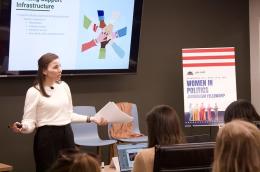
Tracking the number of women in elective office represents only one measure of political power, two Rutgers University researchers told the 2024 National Press Foundation Women in Politics Fellowship.
They say entrenched inequities persist in legislative leadership, fundraising, and the outsized influence of unelected gatekeepers.
“We know that keeping track of women’s political representation, specifically the numbers of women in elective office, is just one piece of a larger puzzle to understanding and addressing disparities in women’s political power,” said Kelly Dittmar, associate professor of political science and director of research Center for American Women and Politics at Rutgers University.
Read here the full article published by National Press Foundation on 25 April 2024.
Image by National Press Foundation
.
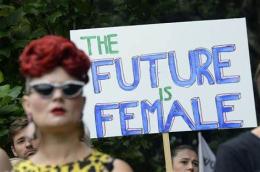
It’s 2024, but power still looks like a man. Despite Australia’s claim to egalitarianism, achieving equal political participation and representation remains a formidable challenge for women. Concerningly, the persistent and ingrained obstacles in women’s way are affecting the aspirations of the next generation of female leaders.
According to 2022 research spanning 29 countries, including Australia, satisfaction among young females aged 15-24 with their leaders’ decisions on issues they care about stands at a mere 11%. An overwhelming 97% acknowledged the importance of political participation. Yet, only 24% of those aspiring to engage in politics could see themselves running for office.
Worse still, 20% have been personally discouraged from political involvement. This is often because they’re either considered to be less qualified or that they will inevitably face discrimination and gendered violence.
I crunched the numbers to assess the situation in Australia. While much has been said about the mistreatment of female leaders, how does this play into the psyche of female constituents?
Read here the full article published by The Conversation on 7 March 2024.
Image source: The Conversation.
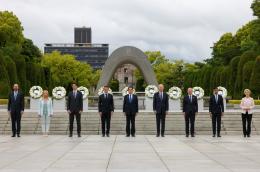
Abstract: While the passage of the 2018 Gender Parity Law was a step in the right direction, progress on women’s political empowerment in Japan has been slow. With a combined effort from advocacy groups, political parties, and the international community to include more women on ballots and support them to electoral success, Japan can move the needle on gender equity in politics.
The annual Group of Seven (G7) meeting invites opportunities for multi-national collaboration but also comparison amongst the attending states. The G7 countries (Canada, the United States, United Kingdom, Italy, Germany, France, and Japan, plus attendance from the European Union) indeed share many things in common: they are all relatively wealthy, liberal democracies committed to working together on global issues. Yet the photos from this year’s meeting highlight another questionable commonality: where aren’t there more women in positions of leadership? A deeper look reveals varying levels of gender equality in politics across G7 members with Japan continuing to lag significantly behind.
Click here to read the full article published by The Asia-Pacific Journal: Japan Focus on 10 December 2023.
Image by The Asia-Pacific Journal
.