Parliaments & Representatives

Women in the Grand Duchy have less confidence in democracy than men, according to a survey from the University of Luxembourg.
Women surveyed repeatedly display a "more cautious, critical and nuanced" attitude towards society, institutions and the workings of democracy, while the men are generally "more assertive and confident", according to the study, published last week by the university’s political observatory POLINDEX.
While men give "a presumption of legitimacy to Luxembourg's institutional structures", women think "more critically [and] more vigilantly, surely reflecting a heightened awareness of the limitations and dysfunctions of the system".

Former Rajasthan chief minister Vasundhara Raje recently asserted that women have to work three times as hard as men to establish themselves in mainstream politics.
Addressing an event in Jaipur on Saturday, the BJP MLA stated, "At the time of Independence, the literacy rate of women in India was 9 percent, and today it is 65 percent. In the country’s general elections, the number of women contesting elections is 10 percent, whereas in 1957 it was only 3 percent."
Raje, who also serves as a national vice-president within her party, strongly emphasised that though the representation of women has increased noticeably in electoral politics since Independence, the growth is simply not sufficient.
She stated, "In the first Lok Sabha, the number of women Members of Parliament was 22, and today it is 74. In the Rajya Sabha, in 1952 the number of women members was 15, and today it has increased to 42. But this number is not enough. This number should be equal to that of men."

Violence against women in politics has become a systemic threat to democratic participation in The Gambia, forcing many women out of leadership spaces through intimidation, harassment, and abuse, a new study by the Westminster Foundation for Democracy (WFD) has revealed.
The findings were unveiled on Friday 23rd January 2026 at the official launch of the Violence Against Women in Politics (VAWP) report, a landmark research conducted under WFD’s Governance for Inclusive and Accountable (GIA) Programme, bringing together government officials, lawmakers, diplomats, civil society, and development partners.

West Virginia has the lowest percentage of women legislators in the country. That fact alone should concern anyone who believes our government works best when it reflects the people it serves.
Misogyny in politics—both loud and quiet—doesn’t just silence women. It silences the communities we represent, and it shapes laws that harm families across our state. Politics has taught me that for women, the reality is never whether misogyny exists, but how much of it we must endure to keep our seat at the table. I learned this firsthand when I ran for office and during my service in the Legislature. This reality is demoralizing not only for women in office, but for the communities we are elected to serve. When women’s voices are ignored or silenced, entire constituencies are cut out of decisions that shape their lives.
The overt forms of misogyny are obvious—sexual harassment and legislation designed to control women’s bodies. But the most corrosive form is the subtle, everyday misogyny women are expected to tolerate just to stay in the room.
Read the full article here.

Gender isn’t just a matter of individual identity. It’s an axis of governance—and for the last year, across a range of policies, the Trump administration has punished women.
Today is the first anniversary of Donald Trump’s inauguration. From ICE deportations to the dismantling of DEI to the criminalization of pregnancy to environmental rollbacks, the administration has narrowed whom it protects and who, through degradations to citizenship, it has determined is expendable.
In this country, gender often determines who bears risks, absorbs costs, and is rendered responsible for the failures of markets and the state. This administration’s policies are, accordingly, especially harrowing for women as well as those who won’t or can’t conform to its gender regime.
Read More here.

The state of women’s rights in Turkey showed no meaningful improvement in 2025, as longstanding problems persisted and new challenges emerged. Femicides, institutional failures to protect women and increasing inequalities in social and political representation remained defining features of the year, with women’s rights defenders continuing to face legal and administrative measures aimed at curbing their activities.
Femicides in 2025 were marked not only by extreme violence but also by judicial processes that renewed concerns over impunity. The case of Rojin Kabaiş, a 21-year-old university student whose body was found three weeks after she went missing, became a striking example of this pattern. Despite authorities’ repeated assertions that her death was a suicide, details brought to light through the persistence of her family and public scrutiny pointed to the possibility of homicide and further intensified concerns over accountability.

Gendered disinformation is being used across Africa as a tactic to silence critics and exclude women from online civic discourses, new research shows.
A new book ‘Digital Disinformation in Africa: Hashtag Politics, Power and Propaganda’ explores this further. It is written by Nkem Agunwa, a digital campaigner focusing on human rights activism based in Nigeria and member of the African Digital Rights Network (ADRN), hosted by IDS.
In an unprecedented year for elections in Africa – with 17 countries heading to the polls, the fear is that digital disinformation poses a rising threat to women’s political participation.
The book references the 2016 study by the Inter-Parliamentary Union of female lawmakers globally which revealed that 41.8 per cent of participants said they have been subjected to degrading or sexual images of themselves being circulate on social media. While gendered disinformation is not new, digital technology allows for collective and coordinated anonymous targeting of people with disinformation. As a result, digital spaces across Africa are increasingly being used to manipulate the public and spread disinformation, or to harass and intimidate individuals, creating an atmosphere of fear and distrust.
Not only does gendered disinformation keep women from participating in democratic processes, but as the book details, it directly threatens the fight for gender equality and inclusivity across Africa.
Read here the full article published by the Institute of Development Studies on 10 May 2024.
Image by Skorzewiak via Shutterstock
.

In recent years, the share of women in public office has surged.
*In 2000, just 65 women served in Congress. Today, the number is 151, more than a quarter of the total 535 voting members.
*Likewise at the state level, women now make up about a third of elected officials.
Yet despite these historic gains, women—who make up roughly half of the population—remain starkly underrepresented in government. And for women of color, the disparity is even greater.
No single factor created this gap, and no single change will fix it. But part of the problem is how campaigns are funded—and changing that will make a significant difference.
It’s expensive to run for office: Political ad spending in the 2024 election cycle is expected to exceed $16 billion. And the price of campaigning is a greater barrier for women, who typically have less access than men to the wealthy donors who provide most of this money.
Enter: public financing, a simple but powerful reform that uses public funds to boost small donations to candidates. It’s a policy that can help any candidate willing to engage with a broad base of voters—but some of its biggest beneficiaries are women, particularly women of color, who make up 25 percent of the country’s population but less than 10 percent of state and federal elected offices.
Read here the full article published by Ms. Magazine on 25 April 2024.
Image by Ms. Magazine
.
A historic law, the Nari Shakti Vandan Adhiniyam, 2023, mandates the reservation of one-third of the total seats in the Lok Sabha, state Assemblies, and the Legislative Assembly of the National Capital Territory of Delhi for women.
In 2023, a historic law was passed to usher more women in governance. The Nari Shakti Vandan Adhiniyam, 2023, mandates the reservation of one-third of the total seats in the Lok Sabha, state Assemblies, and the Legislative Assembly of the National Capital Territory of Delhi for women. But representation in leadership isn’t the only sign of gender parity in politics — active participation of the women electorate is also paramount.
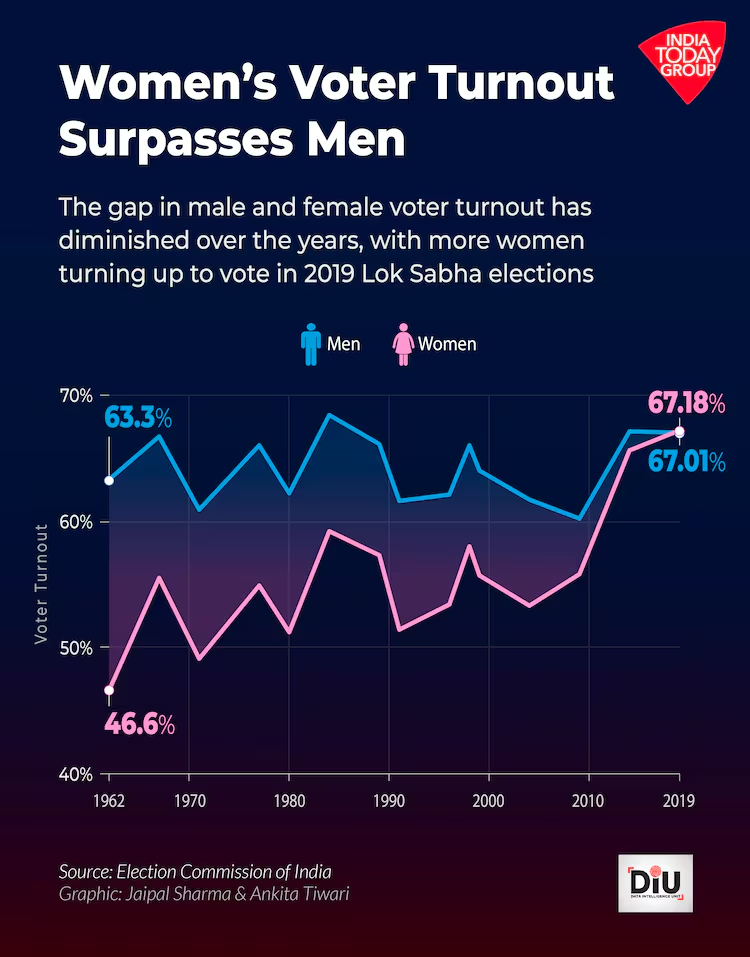
So, how has India fared in both regards so far? India Today’s Data Intelligence Unit analysed the turnout data from 1962 to 2019 and candidates’ data from 1957 to 2019 and found a mostly positive trend.
TURNOUT GAP NARROWED
In 1962, men's turnout stood at 63.3 per cent, while women's turnout was notably lower at 46.6 per cent, indicating a considerable gap of 16.7 per cent. This gap fluctuated over the subsequent decades but generally narrowed. For instance, in 2014, men's turnout was 67.1 per cent, while women's turnout increased substantially to 65.6 per cent, resulting in a smaller gap of 1.5 per cent.
Read here the full article published by India Today on 13 April 2024.
Image source: India Today
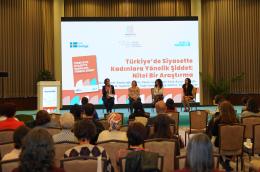
A Qualitative Study on Violence against Women in Politics in Türkiye, prepared in cooperation with UN Women and Terra Development Cooperative, was introduced at an event organized in Ankara. A qualitative study, which provides important findings on the causes, occurrence, and consequences of violence against women in politics, was presented to the representatives from civil society organizations, public institutions, local governments, and political parties.
The Study on Violence against Women in Politics in Türkiye, which was started to be prepared by Prof. Dr. İknur Yüksel Kaptanoğlu, Project Coordinator of Terra Development Cooperative, together with her study team in 2022, was carried out within the scope of the project "Advancing Gender Equality and Women's Leadership in Political and Business Life” implemented by UN Women and financially supported by the Sweden through Swedish International Development Cooperation Agency (SIDA). In her opening speech, Swedish Ambassador to Ankara Malena Mård emphasized the importance of a political environment free from all forms of violence, especially for young people.
Click here to read the full report published by UN Women on 10 January 2024.
.
A Glimpse into the Life of a Women in Politics: CEMR Unveils First Data Coming from 31 Countries
The Council of European Municipalities and Regions (CEMR) has released the first infographics showcasing critical insights from their latest report, "Women in Politics."
The data offer a visual snapshot of the representation of women in elected roles across various subnational levels. Additionally, a detailed breakdown of their portfolios at the local level is provided. The second slide of the infographics unveils the results of an anonymous CEMR survey involving 2,424 participants from 31 countries. Focused on elected women in local and regional European roles, the survey explores their experiences of violence in the political realm.
Click here to see the infographic published by the Council of European Municipalities and Regions on 14 December 2023.
Image by Council of European Municipalities and Regions
.

For a country with a significant female population, Nigeria has been poor in ensuring gender parity in elected and appointed leadership positions. Since 1979, the country has practiced a presidential form of government, with a devolved form of government across three tiers—federal, state and local levels. Yet, despite the number of elective constituencies available, there has been little to no women elected to these positions. Nigeria has never elected a female president, vice-president or a governor in any of its thirty-six states. Women elected to the national legislature have been a scant percentage in any of the ten constituted sessions of either chamber, with none emerging as president of the senate and a roughly five-month stint for the only woman to emerge speaker of the house of representatives (Polgreen, 2007).
Click here to read the full report published by the Centre for Democracy and Development on 27 November 2023.
Image by Centre for Democracy and Development
.